Pearson Edexcel · GCSE · English Language
Course version: 1EN0 · Version from Mar 2026
Fiction and Imaginative Writing - 1.1 Reading: 1.1.2 critical reading and…
Full specification wording
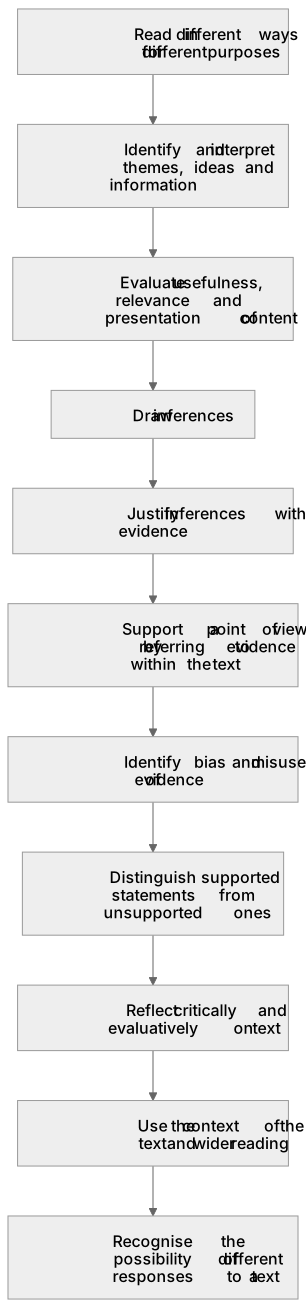
Component 1: Fiction and Imaginative Writing - 1.1 Reading: 1.1.2 critical reading and comprehension: identify and interpret themes, ideas and information in a range of literature and other high-quality writing; read in different ways for different purposes, and evaluate the usefulness, relevance and presentation of content for these purposes; draw inferences and justify these with evidence; support a point of view by referring to evidence within the text; identify bias and misuse of evidence, including distinguishing between statements that are supported by evidence and those that are not; reflect critically and evaluatively on text, use the context of the text and draw on knowledge and skills gained from wider reading; recognise the possibility of different responses to a text
Critical reading involves actively questioning texts.
Checked against the Pearson Edexcel 1EN0 specification (opens in a new tab) on .
- Point 2 of 4
- 3 key terms
Study notes
From the checked teaching notes for this specification point.
The idea
Critical reading involves actively questioning texts. Identify themes like power, interpret ideas, and evaluate how information is presented. Adapt your reading for different purposes: skim for gist or read closely to analyse tone. For example, in a 19th-century extract, judge how a writer presents a character's motives and if the narrative voice encourages sympathy. Draw inferences and justify them with quotations, supporting your viewpoint with evidence. Distinguish evidence-backed claims from unsupported assertions, and spot bias or misuse of evidence through word choice. Reflect critically using context and wider reading, recognising that other readers may respond differently. Extended responses reward this evidence-based evaluation.
What earns the marks
- Identifies and interprets themes, ideas and information accurately across different types of text.
- Adapts reading approach to purpose, evaluating the usefulness, relevance and presentation of content.
- Draws inferences and justifies them with precise textual evidence to support a point of view.
- Identifies bias and misuse of evidence, distinguishing between supported and unsupported claims.
- Reflects critically, using context and wider reading, and recognises alternative valid responses.
Common mistakes and how to put them right
Treating all statements in a text as equally reliable.
Put it right: Check whether each claim is supported by evidence and comment on possible bias or misuse of evidence.
Offering a personal opinion without textual support.
Put it right: Anchor every point in a quotation or close reference and explain how it supports your view.
Assuming there is only one correct interpretation.
Put it right: Acknowledge alternative readings and explain why your interpretation is valid using evidence.
Exam tips
- As this qualification is untiered, texts are chosen to be accessible yet contain complex layers; explore alternative interpretations to access higher marks.
- Underline the command words and the focus of the question before you re-read the text for a specific purpose.
- When evaluating bias, comment on word choice, omission, exaggeration or tone, rather than just accepting what is stated.
Try the lesson
The start of the Component 1: Fiction and Imaginative Writing - 1.1 Reading: 1.1.2 critical reading and comprehension: identify and interpret themes, ideas and information in a range of literature and other high-quality writing; read in different ways for different purposes, and evaluate the usefulness, relevance and presentation of content for these purposes; draw inferences and justify these with evidence; support a point of view by referring to evidence within the text; identify bias and misuse of evidence, including distinguishing between statements that are supported by evidence and those that are not; reflect critically and evaluatively on text, use the context of the text and draw on knowledge and skills gained from wider reading; recognise the possibility of different responses to a text lesson, made from checked teaching notes for this specification point.
Have a go first
Read this extract from a story:
"The old house stood at the end of the lane, its windows shattered and its roof sagging under the weight of the ivy. No one had lived there for decades."
Which statement is supported by evidence in the extract?
Listen
Critical reading involves actively questioning texts. Identify themes like power, interpret ideas, and evaluate how information is presented. Adapt your reading for different purposes: skim for gist or read closely to analyse tone. For example, in a 19th-century extract, judge how a writer presents a character's motives and if the narrative voice encourages sympathy. Draw inferences and justify them with quotations, supporting your viewpoint with evidence. Distinguish evidence-backed claims from unsupported assertions, and spot bias or misuse of evidence through word choice. Reflect critically using context and wider reading, recognising that other readers may respond differently. Extended responses reward this evidence-based evaluation. A strong answer earns marks for these points. Identifies and interprets themes, ideas and information accurately across different types of text. Adapts reading approach to purpose, evaluating the usefulness, relevance and presentation of content. Draws inferences and justifies them with precise textual evidence to support a point of view. Identifies bias and misuse of evidence, distinguishing between supported and unsupported claims. A common slip: Treating all statements in a text as equally reliable. Instead, check whether each claim is supported by evidence and comment on possible bias or misuse of evidence. Exam tip: As this qualification is untiered, texts are chosen to be accessible yet contain complex layers; explore alternative interpretations to access higher marks.
See it
Key words
Say what each word means before you turn the card.
Critical evaluation of themes and ideas
Try answering aloud or in your head before turning the card.
Evidence-based argument and inference
Try answering aloud or in your head before turning the card.
Bias, reliability and multiple interpretations
Try answering aloud or in your head before turning the card.
See every definition
- Critical evaluation of themes and ideas
- Reflecting critically and evaluatively on text, using its context and drawing on knowledge and skills gained from wider reading.
- Evidence-based argument and inference
- Drawing inferences and justifying these with evidence, and supporting a point of view by referring to evidence within the text.
- Bias, reliability and multiple interpretations
- Identifying bias and misuse of evidence, distinguishing between statements supported by evidence and those that are not, and recognising the possibility of different responses to a text.
Label the diagram
Some boxes have lost their names. Pick the right name for each number.
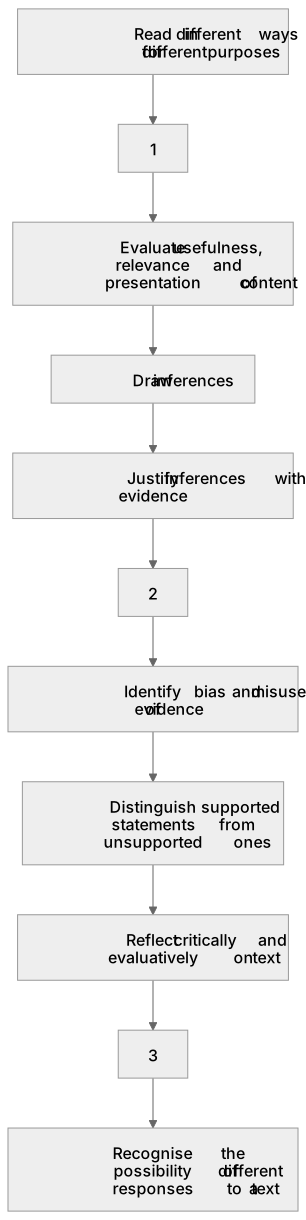
1Box 1
2Box 2
3Box 3
There is more to this lesson
The full lesson goes on to check your understanding and help you earn the marks. Create a free account to carry on, with your progress saved.
A week of Premium from your first lesson · Then the free plan continues · No card, no charge
Test your understanding of Component 1: Fiction and Imaginative Writing - 1.1 Reading: 1.1.2 critical reading and comprehension: identify and interpret themes, ideas and information in a range of literature and other high-quality writing; read in different ways for different purposes, and evaluate the usefulness, relevance and presentation of content for these purposes; draw inferences and justify these with evidence; support a point of view by referring to evidence within the text; identify bias and misuse of evidence, including distinguishing between statements that are supported by evidence and those that are not; reflect critically and evaluatively on text, use the context of the text and draw on knowledge and skills gained from wider reading; recognise the possibility of different responses to a text
Active recall beats re-reading. Take an instant quiz now to test what you’ve learned and lock it into long-term memory.
A week of Premium from your first lesson · Then the free plan continues · No card, no charge